
Home › Treatments › Hair transplant for women
Hair transplant for women
In women, identifying the cause of hair thinning is particularly important. A hair transplant can only be considered with an appropriate indication and a suitable donor area; otherwise, hair preservation treatment may be appropriate.
17 years of experience · 2000+ procedures · 4.8★ Google · 24 ISHRS courses
Before
After
Hair transplant for women
Female hair thinning: from identifying the cause to an individual plan
A widening parting, thinning on top of the head and changes to the hairline can indicate different situations. At the first appointment, we therefore discuss how your hair loss has developed, your previous treatments and your goals. The option of a hair transplant can be considered after an examination and an assessment of the donor area. For Type I, a hair transplant is generally not yet recommended, subject to individual assessment.
How is hair transplantation performed for women?
A hair transplant (also known as hair transplantation or hair restoration) refers to the process of redistributing hair follicles in women and men alike. During the procedure, hair follicles that are resistant to the balding process are removed and then placed in the recipient area.
The number of hair follicles available for relocation varies from person to person, and the supply is limited. It is important to use the patient's donor area wisely and to remove only the number of hair follicles that is necessary, so that enough reserve remains for a possible future hair transplant in case thinning of the original, non-transplanted area progresses. One of the advantages of hair transplantation for women is the use of the newly developed Long Hair FUE technique, so our female patients do not need to cut their hair short, and the result is visible almost immediately.
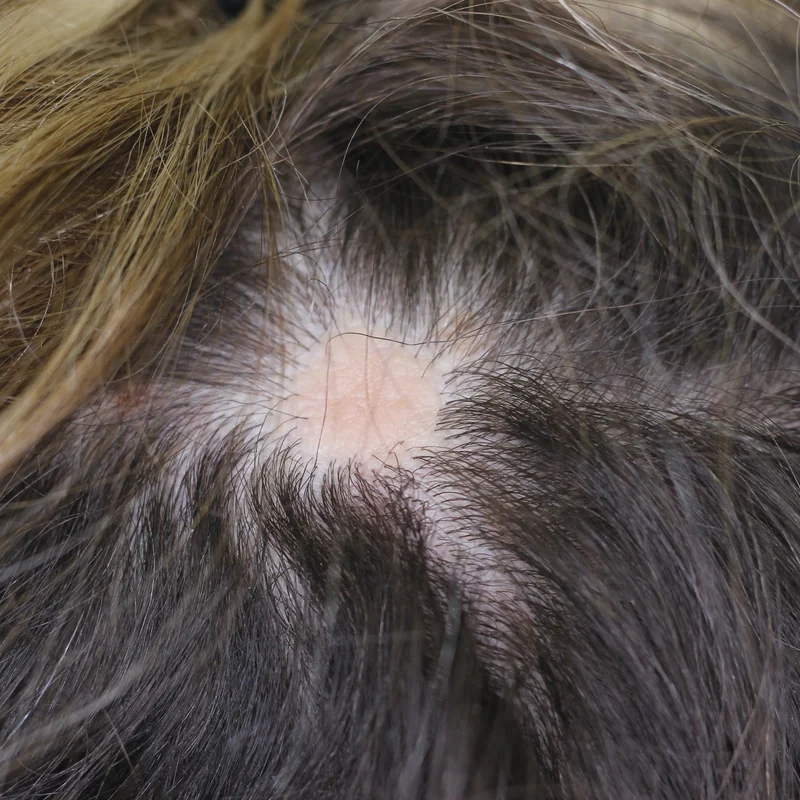
Before
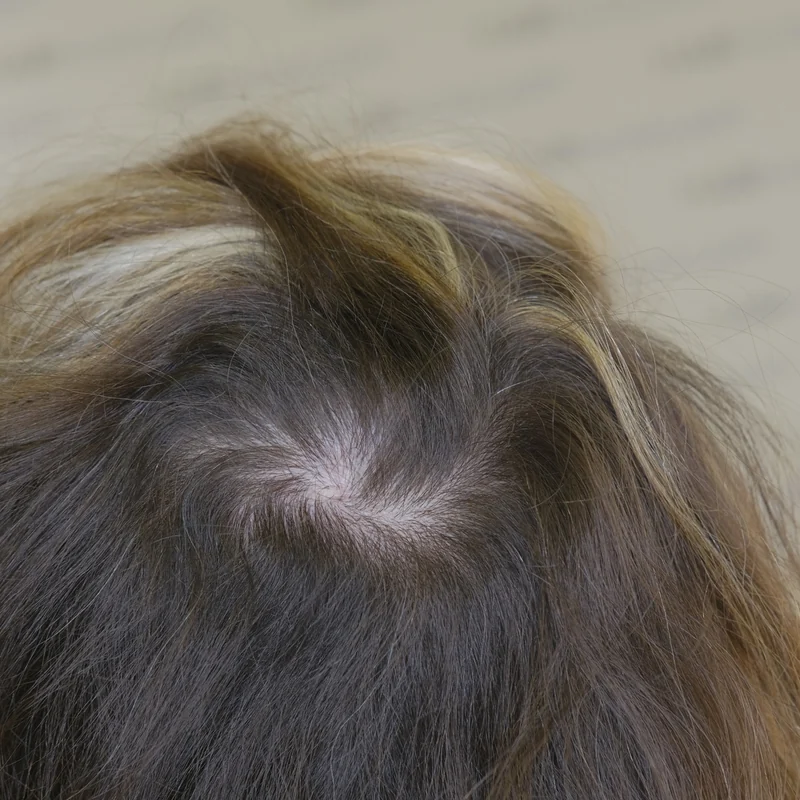
After
Thinning crown 12 months after the transplant.
What technique do we use for female hair transplantation?
We use the hair extraction method patented by Dr. Roberto Trivellini, so that the donor area suffers as little trauma as possible and we can achieve the most precise result possible. The toolkit at our disposal is currently the only multiphasic system accepted by the profession, and its device incorporating the long-hair extraction function is the aforementioned Long Hair Trivellini Mamba. Among the device's settings, the operator can choose a special option which, together with a specially developed needle, allows the follicular units to be removed in long-hair form without damage and implanted in the same form, just as in a normal FUE procedure; the difference, however, is the presence of the long hair at the end of the follicular unit.
The procedure is always preceded by a thorough medical consultation, where we assess your needs and explore your options so that the final result is as aesthetically optimal as possible while remaining completely natural.
Using the most advanced medical technique, we transplant active hair follicles from the area around the nape of the neck to thinner areas; these follicles are insensitive to hormonal changes, so they will not die off over time. Cell regeneration technologies are effective both during the healing period after surgery and in reactivating your own, non-transplanted hair follicles, which is why at our clinic the regenerative therapy we use is a standard part of the surgical protocol rather than being listed as an extra service.
With the Trivellini FUE hair transplant system, we can adapt the instrument to each patient's individual characteristics in meticulous detail, increasing speed and precision while minimising surgical trauma.
Hair thinning patterns and surgical options
The Ludwig scale helps describe the pattern of female hair thinning. The scale does not replace a medical examination of the donor area and of the cause of hair loss.
The three stages of the Ludwig classification
The Ludwig classification consists of three stages describing female-pattern genetic hair loss:
- Type I (mild)Early thinning of the hair occurs, which can still be easily concealed with the right combing. At this stage, not enough hair has been lost for hair transplantation to be an option for women.
- Type II (moderate)In women with Type II hair loss, the central parting widens and the density of hair on the scalp decreases noticeably. A hair transplant can be performed if the patient has donor areas with stable hair at the back and sides of the scalp.
- Type III (extensive)The top of the scalp becomes almost completely see-through, which is usually accompanied by thinning across the entire scalp. Patients at this stage often have too few donor hairs for a hair transplant to deliver adequate results.
The examples above are general; an exact diagnosis is made at the personal consultation.
The process
- 1Call back and arranging a personal consultation.
- 2Medical assessment and an individual treatment plan.
- 3The agreed procedure and follow-up.
Price and consultation
Base procedure fee (0–500 grafts)
HUF 600,000
The further graft fees are listed in the detailed price list.
Personal medical consultation
HUF 25,000
If you choose a procedure or a package, the consultation fee is deducted.

The HairHungary specialist
Dr. Dávid Zakariás
Doctor, hair transplant specialist
24 ISHRS courses, 50+ credits
Medical consultation: HUF 25,000
Request a call back!
For any questions or to arrange a consultation appointment:
Please fill in our form and our colleague will call you back at the time you indicated!